
Blog · 11 October 2026
6 principles for leading with agility and awareness
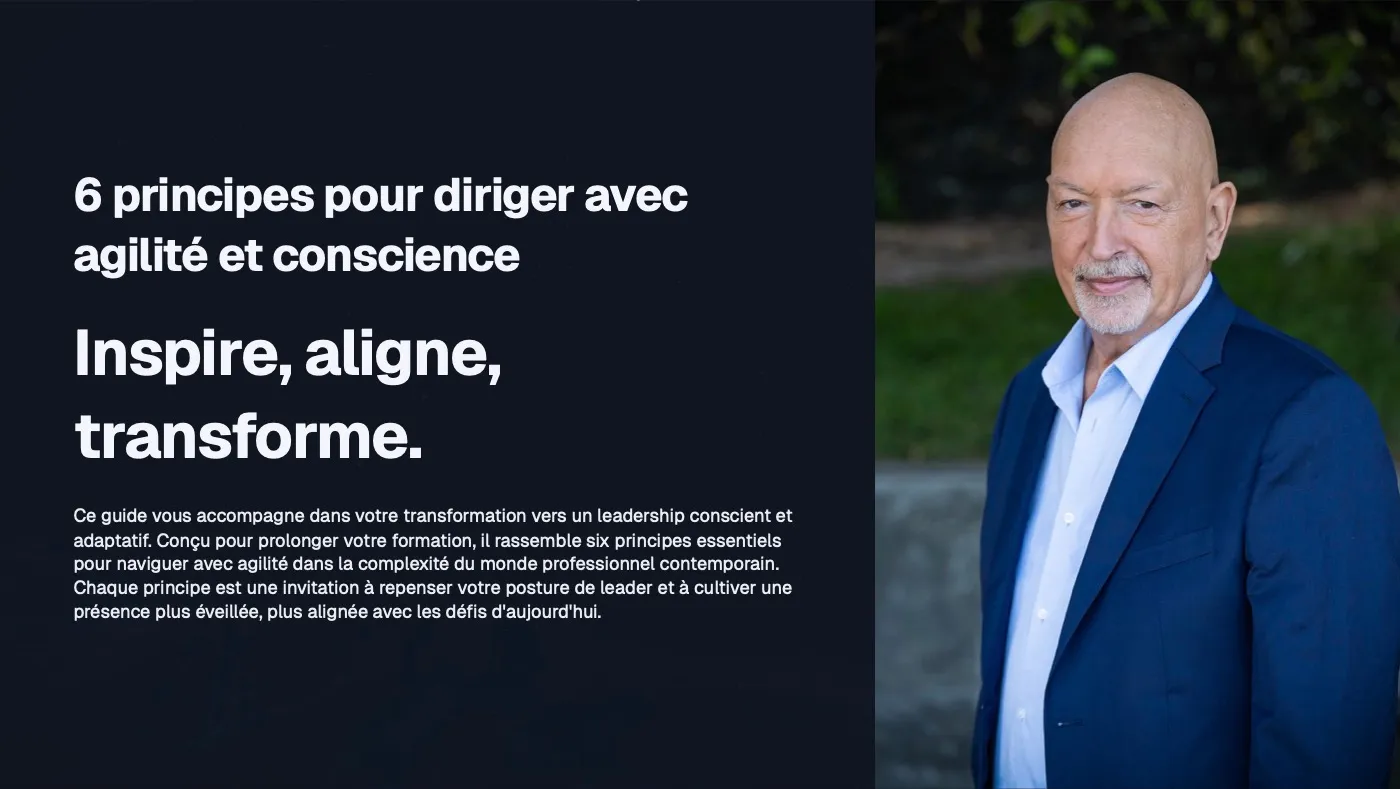
This guide walks you toward conscious, adaptive leadership. It brings together six principles to help you move with agility through the complexity of working life. Each one invites you to rethink your stance as a leader and to build a more awake presence, more in tune with today’s challenges.
Leading with presence and awareness
1. Lead with antennas, not just with objectives
“The adaptive leader senses before deciding.”
Before you push a strategy, watch for weak signals: small shifts in behavior, unspoken expectations, tensions that keep coming back. A leader’s intelligence lies in the ability to notice what is emerging before it becomes urgent.
To practice: take the radar stance. Listen, feel, pick up the signals, then align. Build an attentive presence that lets you spot the quiet movements in your organization.
2. Change your relationship with uncertainty
“It isn’t uncertainty that holds you back, it’s the fear it creates.”
Instead of trying to control what you can’t predict, train yourself to treat it as ground to explore. Uncertainty isn’t the enemy of leadership: it’s the natural setting in which agility unfolds.
To practice: ask yourself, “What does this situation show me about our ability to change?” Turn every unclear moment into a chance to learn together.
Simplifying the organization and helping things flow
3. Simplify without stripping things bare
“A system becomes intelligent when it learns to shed what it doesn’t need.”
Lighten procedures, clarify roles, make communication flow. An organization’s complexity often comes from layer after layer that weighs it down without adding anything.
To practice: an organization’s adaptivity depends less on its size than on the quality of what flows inside it. Ask yourself regularly: “What can we remove without weakening our ability to act?”
4. Turn every tension into a chance to grow
“Tensions aren’t problems to solve, they’re forces for change to channel.”
Every tension felt in a company signals a gap between what is and what could be. These frictions show exactly where the organization needs to change.
To practice: look into these gaps and bring lasting answers instead of smothering them. Build a culture where everyone can name a tension and explore it without being judged.
Building collective energy
5. Create spaces for renewal
“An exhausted leader can’t inspire.”
The brain needs room to breathe to see the bigger picture. Your company will be more flexible if it alternates between action and integration. Lasting performance comes from this rhythm between intense commitment and conscious recovery.
To practice: create shared breathing spaces: emotional debriefs, sensory breaks, honest feedback. This isn’t wasted time, it’s an investment in the quality of your relationships and in the team’s clear-sightedness.
6. Move from performance to collective awareness
“The adaptive company isn’t a sum of talents, it’s a conscious symphony.”
Build cooperation, shared responsibility and a common vision. The real lever for change isn’t the sum of everyone’s skills, but the quality of the connection and alignment between people.
To practice: make every team member a sensor of reality and a driver of change. Build a culture where intelligence is shared and where everyone feels responsible for the common direction.
Suggested ritual: once a week, 15 minutes where the team shares not what was done, but what was felt. This ritual builds the team’s emotional intelligence and strengthens cohesion.
In short
- Take care of your own energy: look after yourself so you can guide others better.
- Inspire a shared vision: bring your team together around a common goal.
- Unlock everyone’s potential: trust people and give them responsibility.
- Create spaces for renewal: breaks to integrate better and stay flexible.
- Build collective awareness: cooperation and shared responsibility.
- Act with intention and observation: experiment and learn from what changes.
Your next step
Pick one of these principles and commit to applying it every day for 30 days. Notice what changes in your leadership and in your team. Conscious leadership is a path made of small steps and big realizations, not a destination.